AudiogramIQ
Previously published as AudiAnalytix Enterprise.
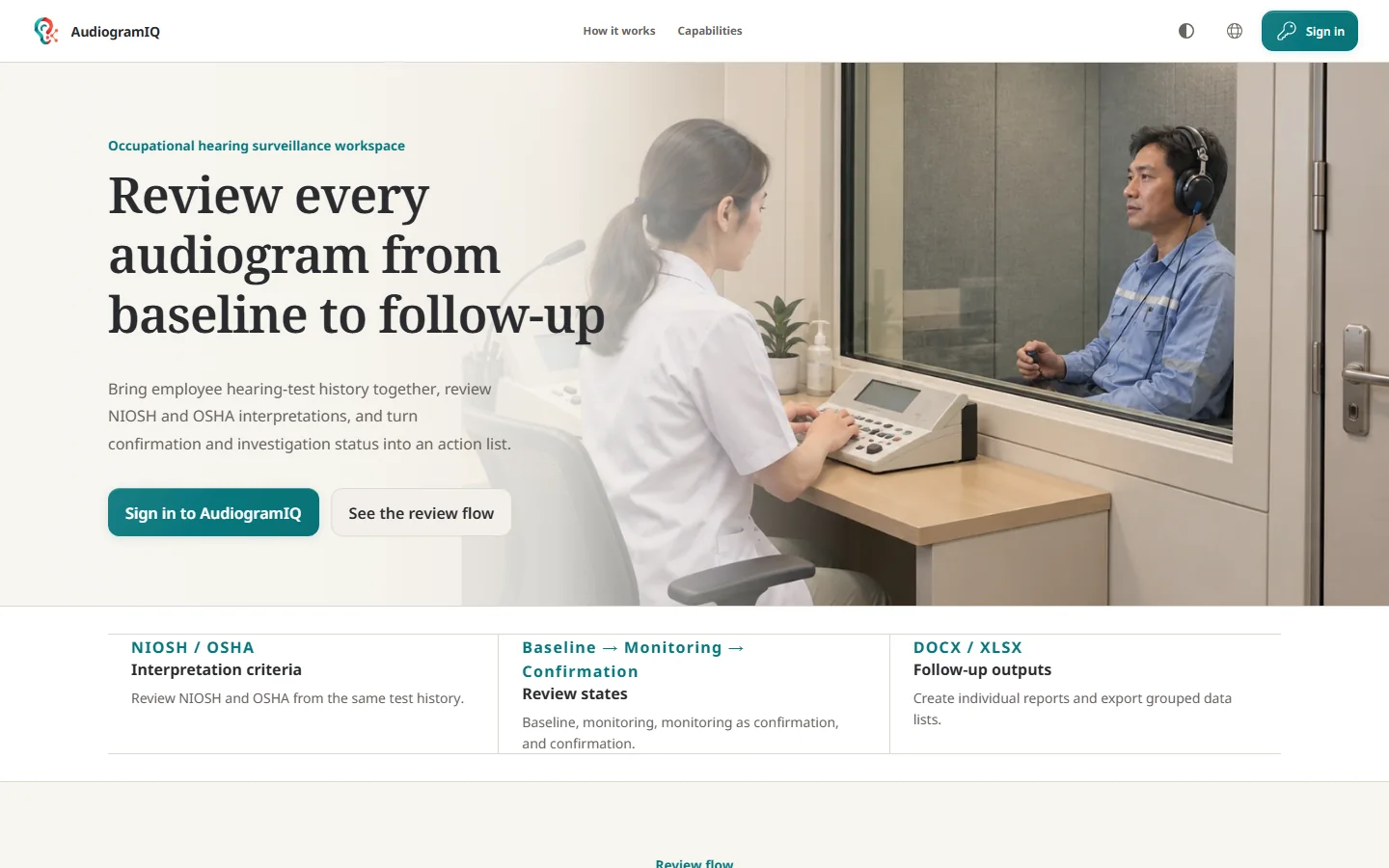
A workplace hearing-surveillance workspace connecting test history, baseline comparison, NIOSH and OSHA interpretations, and follow-up reporting.
- Test history and the selected baseline kept in context.
- NIOSH and OSHA interpretations connected to confirmation and investigation.
- Individual DOCX reports and grouped XLSX exports for follow-up.
Context
Occupational hearing-conservation programmes depend on repeated audiograms, baseline comparisons, follow-up rules, and reports that can still be reviewed after the examination day. When those steps live in separate files, the clinician spends time rebuilding the evidence before deciding what it means.
Problem
Raw thresholds are not the end of the workflow. The reviewer needs to see the audiogram, understand which baseline was used, identify meaningful changes, and keep the underlying values available when an automated interpretation needs to be checked.
Suttisak’s role
Suttisak defined the clinical workflow, product scope, interpretation requirements, interface direction, and full-stack implementation. The work joins occupational-medicine knowledge with software design rather than translating a finished specification from another team.
What was built
- Hearing-test entry and structured Excel import with a preview before changes are committed.
- Employee test history and comparison against the selected baseline.
- NIOSH and OSHA interpretations within the same review workflow.
- Yearly confirmation and investigation status for follow-up.
- Individual DOCX reports and grouped XLSX exports.
Design story
Keep the evidence beside the interpretation
An audiogram’s thresholds, chosen baseline, and possible shift findings need to remain understandable together. The review connects successive tests to the selected baseline and shows NIOSH and OSHA interpretations in that context. A generated finding remains something to check against the source values, alongside professional judgement.
Make the next action visible
Baseline, monitoring, and confirmation describe different points in the review. The workflow keeps those states visible and brings confirmation and investigation status into yearly follow-up lists. This gives the reviewer a path from an interpretation to the work still needing attention.
Carry that context into reporting
An individual DOCX report and a grouped XLSX list serve different follow-up tasks. Both belong to the same sequence as entry, baseline comparison, and review. The public introduction follows that order too, so teams can understand the workspace before signing in.
Key workflow
- Record the hearing thresholds or preview a structured Excel import.
- Select and verify the relevant baseline.
- Review the test history and NIOSH and OSHA interpretations.
- Review confirmation and investigation status for follow-up.
- Prepare an individual report or grouped export for the hearing-conservation process.
Constraints
Clinical review must remain possible at every step. Automated analysis supports judgement; it does not replace it. Source values, baseline choices, and the reasoning behind a finding must remain easy to inspect.
Outcome
AudiogramIQ provides one repeatable path from threshold data to a reviewable occupational-health result, making the logic easier to inspect, explain, and carry into the wider hearing-conservation process.